
What Breaks First When a Small Business Starts to Grow
Growth is what founders work toward. More clients, more revenue, more reach. And then it arrives: something unexpected happens.
The business starts to feel harder to run, not easier. Decisions that used to take minutes now take days. The team is waiting on answers. Clients are waiting on deliverables. And the founder, who built this thing from nothing, is somehow the reason everything has slowed down.
This is one of the most common patterns I've watched play out in growing businesses. And it almost always starts in the same place.

The Founder Becomes the Bottleneck
In the early days of a business, the founder being at the center of everything makes sense. She knows the clients, she knows the work, she knows the vision. Her judgment is the product. Her availability is the engine.
But a business that grows doesn't outgrow its revenue goals first. It outgrows its founder's capacity first.
What that looks like in practice: every decision, large or small, routes back to her. A team member needs approval to move forward. A client has a question only she can answer. A vendor needs a response she hasn't had time to send. The calendar is full, the inbox is full, and there is no slack in the system for anything unexpected.
She isn't failing. She's just running a business that was built for a smaller version of itself.
Why This Happens
The founder becoming the bottleneck isn't a character flaw. It's a structural problem that grows naturally out of how most small businesses are built.
In the beginning, keeping everything centralized works. It's efficient. It protects quality. It keeps the founder close to the work she cares about. But those same centralized decisions that worked at five clients don't work at 15. The informal systems that held things together when the team was two people start to crack when it's five.
The business grows. The structure doesn't. And the gap between the two is where the bottleneck lives.
I've watched this happen with founders who are exceptionally talented, deeply organized, and genuinely committed to their teams. The problem isn't who they are. It's that nobody told them the infrastructure needs to grow before the business does, not after.
What the Bottleneck Actually Costs
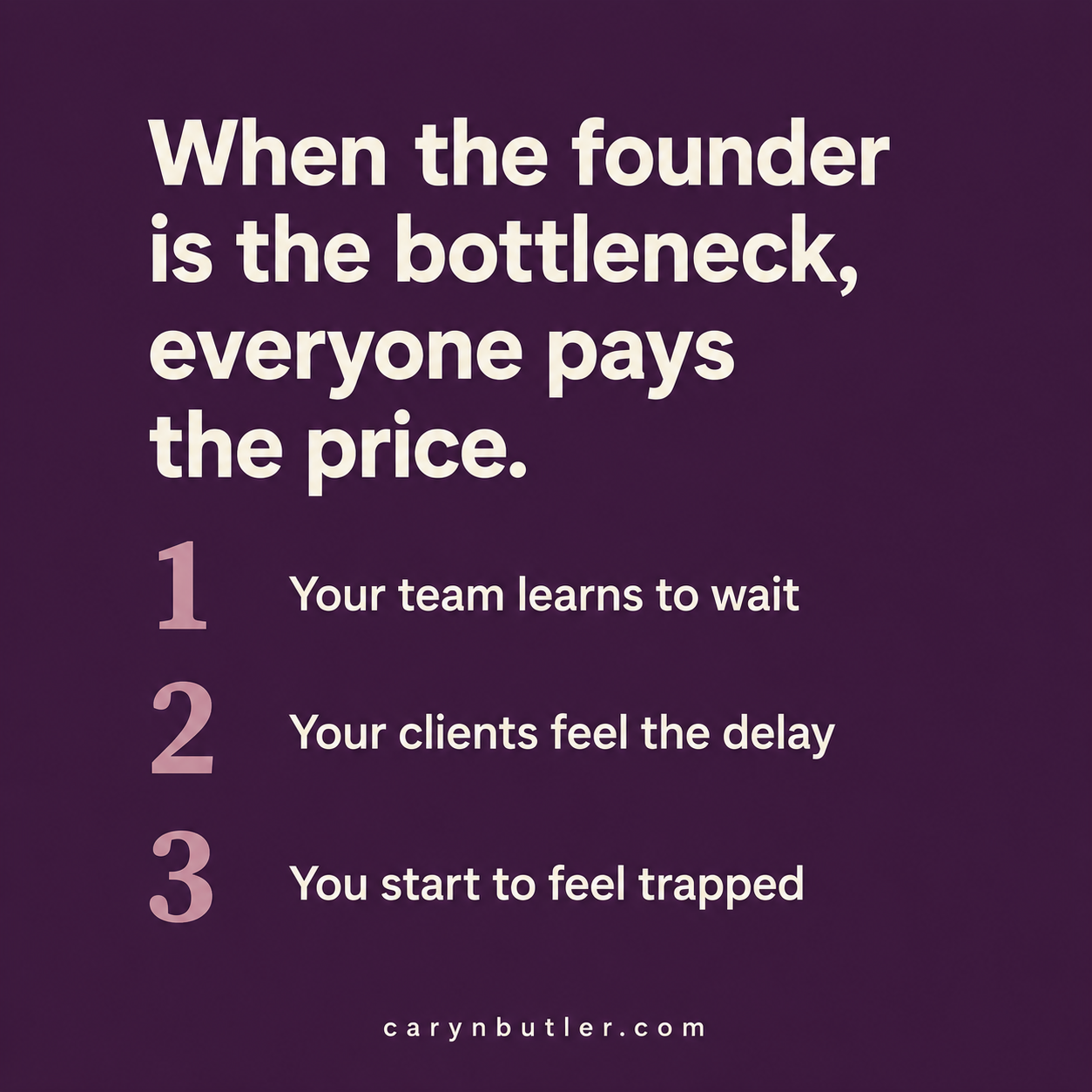
When the founder is the bottleneck, the cost isn't just her time. It's the whole business.
Her team learns, often without realizing it, to wait. To pause before moving forward. To check in before deciding. What looks like caution is actually a cultural signal: we don't move without her. That learned dependence slows everything down and makes it harder to delegate meaningfully when she's finally ready to.
Her clients feel it too. Response times stretch. Deliverables get delayed not because the work isn't good but because there aren't enough hours in the founder's day to move everything forward at once.
And the founder herself starts to feel the weight of being needed for everything. What felt like being indispensable starts to feel like being trapped.
What Needs to Happen Instead
The shift isn't about working harder or getting better at managing time. It's about building a business that can operate without every decision running through one person.
That starts with identifying which decisions actually require the founder's judgment and which ones don't. Most founders, if they're honest, will find that a significant portion of what lands on their plate doesn't need them specifically. It needs a clear process, a trusted team member, or a documented standard that removes the need for a decision at all.
It also means building communication structures that give the team enough information to move forward independently. Not micromanagement in reverse — not handing off everything at once — but a deliberate and gradual transfer of decision-making to the right people at the right level.
This is operational work. It's not glamorous and it doesn't happen overnight. But it's the work that determines whether a growing business scales or stalls.
A Question Worth Asking Now
You don't have to be in crisis to do this work. In fact, the best time to address it is before the bottleneck becomes obvious to everyone around you.
Ask yourself this: if you were unavailable for a week, what would stop moving in your business?
The honest answer to that question is your operational roadmap. Everything that stops is worth examining. Some of it should stop. A lot of it probably shouldn't.
Growth is the goal. But the business has to be built to hold it.
Caryn Butler is a Strategic Operations Partner who works with founders and growing businesses to bring clarity, structure, and calm to the complexity of running a business. Learn more at carynbutler.com.